Deploying an API using YAML files is one thing. Understanding what happens behind the scenes makes the architecture much easier to work with.
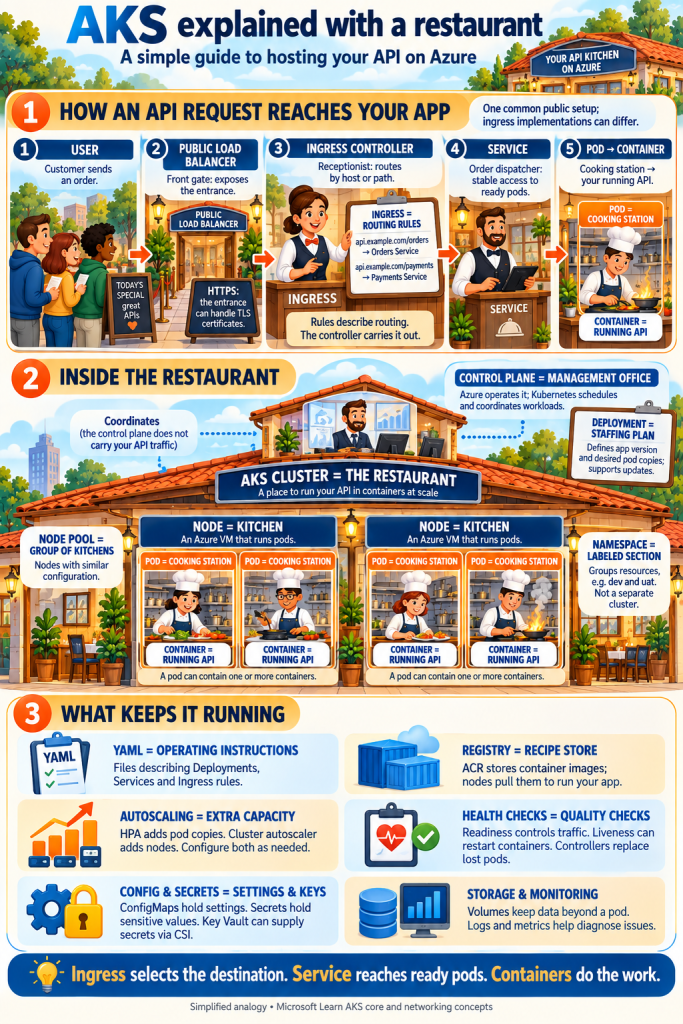
Here’s a simple way to picture Azure Kubernetes Service:
🏠 AKS cluster — The restaurant
The overall setup where your applications run.
👨🍳 Nodes — The kitchens
Azure virtual machines that provide resources to run your workloads.
🔥 Pods — The cooking stations
Each pod contains one or more containers. Think of your API container as the chef doing the actual work.
📋 Ingress — The reception rules
These specify where requests should go based on the hostname or URL path.
🙋 Ingress controller — The receptionist
It follows those rules and routes requests to the right Service.
🧾 Service — The order dispatcher
It gives your application a stable access point and directs requests to ready pods.
👔 Kubernetes — The restaurant manager
It coordinates workloads and keeps the desired number of pod copies running.
📈 Autoscaling — Preparing for busy hours
When configured, pod autoscaling adds application copies, while node autoscaling adds computing capacity.
The key distinction I wanted to highlight:
Ingress selects the destination. Service reaches ready pods. Containers do the work.
The infographic brings these pieces together, along with deployments, YAML, health checks, configuration and secrets.
Which AKS concept took you the longest to understand?


Leave a Reply